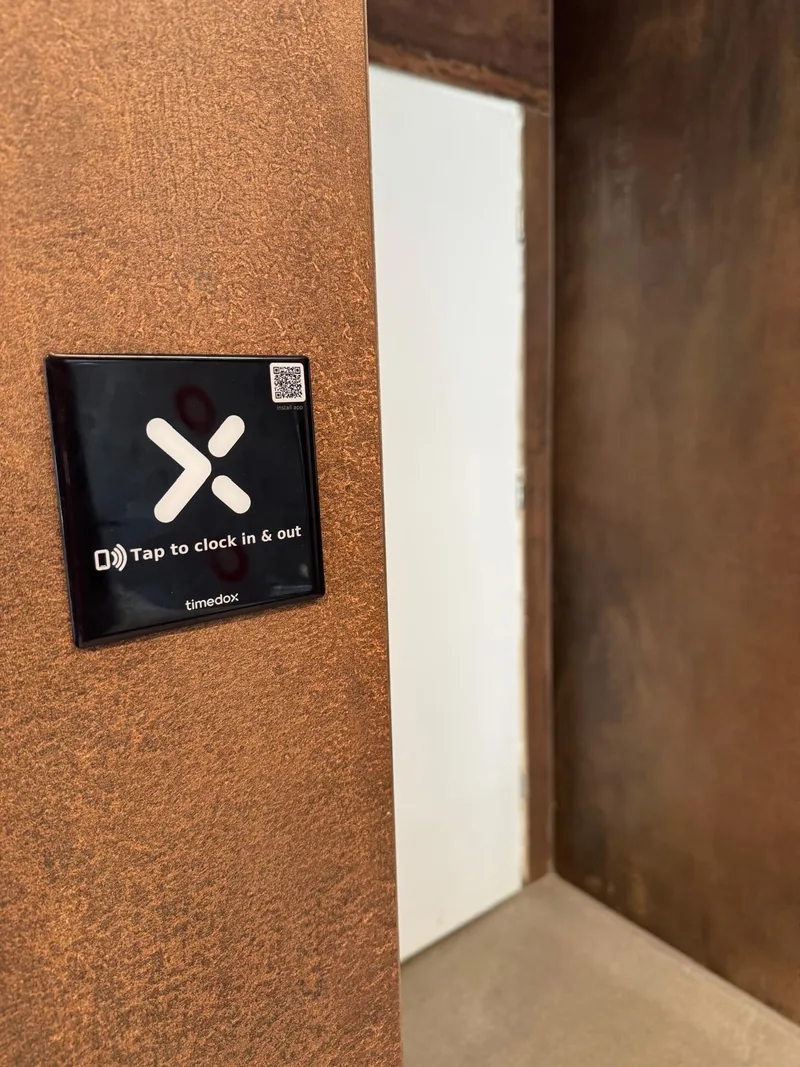
The NFC time clock with the stickers included
Employees tap their phone on an NFC sticker to clock in. No reader hardware, no batteries, and no per-device fee. Add a clock-in point at any door or job site for a few dollars, and pair it with GPS and biometric clocks in one system.
What is NFC time tracking?
NFC time tracking lets employees clock in and out by tapping their phone on a small NFC sticker placed at a location. NFC (near-field communication) is the same contactless technology used for phone payments. Because the tap has to happen at the physical tag, each punch is tied to a real place and time, giving you accurate on-site attendance without a wall-mounted machine or a card reader.
How NFC clock-in works
Stick an NFC tag
Peel and place an NFC sticker at each door, entrance, or job site. No wiring, no reader, no batteries.
Open the Timedox app
Employees open the Timedox app on their own iOS or Android phone as they arrive.
Tap to clock in
They tap the back of the phone on the sticker. The tap records a timestamped punch tied to that spot.
It syncs automatically
The punch flows into your Timedox timesheets and reports, ready for payroll.
Why teams use NFC attendance
A few dollars per point
NFC stickers cost a few dollars each, so you add clock-in points instead of buying another device.
No reader hardware
Modern iOS and Android phones read NFC. The employee's own phone is the reader.
No batteries, no power
The stickers are passive. Nothing to charge, wire, or maintain.
Proof of on-site presence
The tap has to happen at the physical tag, so it confirms someone was actually at the location.
Works in tough spots
Put a tag anywhere: gates, basements, trailers, remote sites. No network at the tag itself.
Pairs with GPS and biometrics
Combine NFC with GPS or a fingerprint clock for stronger verification in one system.
NFC vs RFID, biometric, and GPS
Each clock-in method fits a different situation. With Timedox you can mix them, so this is about the right tool per location, not one winner.
The stickers are included, not bring-your-own
Many time-tracking apps say they "support NFC," but you have to source your own tags and hope they work. Timedox sells ready-to-use NFC stickers, a few dollars each, that activate with your account in minutes. They work alongside the TDX-TP200 fingerprint and face clock and GPS mobile clock-in, so you run one attendance system instead of stitching together tools.
Frequently asked questions
What is an NFC time clock?
An NFC time clock lets employees clock in by tapping their phone on an NFC sticker or tag placed at a location. The tap records a timestamped punch tied to that spot, so you get accurate, on-site attendance without a bulky machine.
How does NFC clock-in work?
Place an NFC sticker at the door or job site. An employee opens the Timedox app and taps the back of their phone on the sticker. The punch is logged with a timestamp and syncs to your timesheets automatically.
How much does NFC time tracking cost?
Timedox NFC stickers are a few dollars each (a 3-pack is $39.99), plus the flat $3 per employee per month for the software. There is no reader hardware to buy and no per-device fee.
Do you need special hardware for NFC clock-in?
No reader is needed. Modern iOS and Android phones read NFC, so the employee's own phone does the work. You only place the passive stickers, which need no power or batteries.
NFC vs RFID for time tracking, what is the difference?
RFID usually needs a card for each employee plus a reader at the door. NFC uses the phone employees already carry to tap a cheap sticker, so it is faster and lower cost to deploy.
Does NFC attendance stop buddy punching?
The tap has to happen at the physical tag on-site, which prevents remote clock-ins. For stronger verification, pair NFC with GPS or a fingerprint clock, all in the same Timedox system.
Add tap-to-clock in minutes
Get Timedox NFC stickers, place them anywhere, and your team taps to clock in. Start 30 days free.